
What is NLP – and how can you benefit?
My Intention for Studying NLP, and how we can work together.
My first encounter with NLP was in 2017 when I studied with Paul Mischel, a well respected Melboure Hypnotherapist. Back then the state of my parenting and business journey were not allowing me to continue. However, the learnings and curiosity persisted.
My aim is to continue to understand how our thinking, feeling and our physiology (our body) influence each other, how our brain works and how our thoughts & minds shape our behaviour and with that our experiences and the quality of our lives.
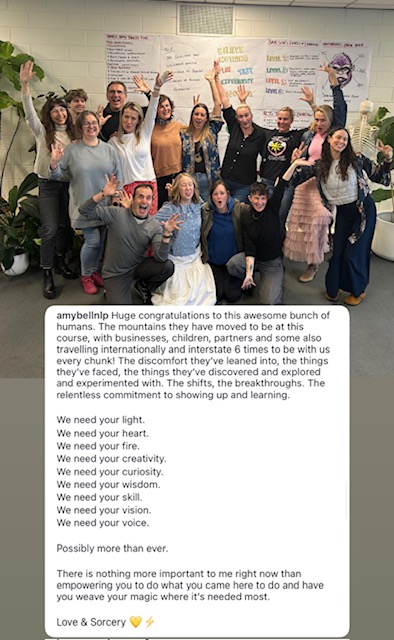
On Sunday I graduated with 4 certifications and a heart full of gratitude, new skills, connections and an expanded perspective on my personal and professional life. And I’m excited to bring all the learnings, techniques, procedures and principles into all of my work, particularly my 1-1 coaching sessions to benefit you.
If you aim to improve your communication, if you’re stuck with a decision, pain, circumstances, relationships, or simply are in a rut and don’t know which steps to take, or if you’re wanting to shift a habit, belief or addiction, or you simply want to open the gateway of possibilities, and aim to heal, grow, change and expand deeper and faster, help is here.
Open the doorway of what is possible and reach out for an initial chat. Or book in for a 1-1 NLP based coaching session, via the usual channels.
NLPs Origins & Ideas.
NLP stands for ‘Neuro Linguistic Programming’ and has been around since 1970’s when its co-founders, Richard Bandler and John Grinder first modelled the therapists Milton Erickson, Gregory Bateson, Fritz Perls and Virginia Satir. A literal translation of the phrase ‘Neuro Linguistic Programming’ is that NLP empowers, enables and teaches us to better understand the way our brain (neuro) processes the words we use (linguistic) and how that can impact on our past, present and future (programming). It gives us strategies for observing human behaviour and learning from the best (and worst) of that!
NLP has been defined as the “users manual for your mind” because studying NLP gives us insights into how our thinking patterns can affect every aspect of our lives.
“NLP is an attitude which is an insatiable curiosity about human beings with a methodology that leaves behind it a trail of techniques.“
Richard Bandler (co-creator of NLP)
“The strategies, tools and techniques of NLP represent an opportunity unlike any other for the exploration of human functioning, or more precisely, that rare and valuable subset of human functioning known as genius.“
John Grinder (co-creator of NLP)
Applications: Relevant to you and my work with you.
NLP is a powerful resource to have – NLP strategies, tools and techniques can be applied to a wide variety of scenarios, challenges and changes in our lives and the lives of those around us.
Personal Development
- 1 to 1 coaching
- Managing specific challenges
- Anxieties, fears and stress, trauma
- Presentations and Performance
- Parenting
- Relationships
- Emotional Regulation
- Career Changes
- Conflict Resolution
- Communication Skills
- Weight Loss
- Smoking cessation
- Addictions
Supportive Counselling/ Clinical Therapy
-
- Depression
- Anxiety
- Panic Attacks
- Grief
- Trauma
- PTSD
- Addiction
- Dissociation
Presuppositions of NLP – kind assumptions that help us see ourselves and the world in a respectful and human way.
As well as a set of powerful skills, NLP is a philosophy and an attitude that is useful when our goal is excellence in whatever we do. I invite you to discover what happens in your life if you simply ‘act as if’ the following statements are true…
- Have respect for the other person’s model of the world. (We are all unique and experience the world in different ways. Everyone is individual and has their own special way of being).
- The map is not the territory. (People respond to their ‘map’ of reality, not to reality itself. How people make sense of the world around them is through their senses and from their own personal experience; this means that each individual’s perception of an event is different).
- We have all the resources we need (Or we can create them. These resources can be internal or external, which is a useful reminder that sometimes, believing this enables us to be better empowered in any situation).
- Mind and body form a linked system. (Your mental attitude affects your body and your health and, in turn, how you behave).
- If what you are doing isn’t working, do something else. (Flexibility is the key to success).
- Choice is better than no choice. (Having options can provide more opportunities for achieving results).
- We are always communicating. (Even when we remain silent, we are communicating. Non-verbal communication can account for a large proportion of a message).
- The meaning of your communication is the response you get. (While your intention may be clear to you, it is the other person’s interpretation and response that reflects your effectiveness. NLP teaches you the skills and flexibility to ensure that the message you send equals the message they receive).
- There is no failure, only feedback. (What seemed like failure can be thought of as success that just stopped too soon. With this understanding, we can stop blaming ourselves and others, find solutions and improve the quality of what we do).
- Behind every behaviour there is a positive intention. (When we understand that other people have some positive intention in what they say and do (however annoying and negative it may seem to us), it can be easier to stop getting angry and start to move forward).
- Anything can be accomplished if the task is broken down into small enough steps. (Achievement becomes easier if activities are manageable; NLP can help you learn how to analyse what needs to be done and find ways to be both efficient and effective).
Together let’s explore the limitless nature or your potential and perception.
I’m here to answer any questions you may have.
Talk soon,
Bettina Pfannkuch